
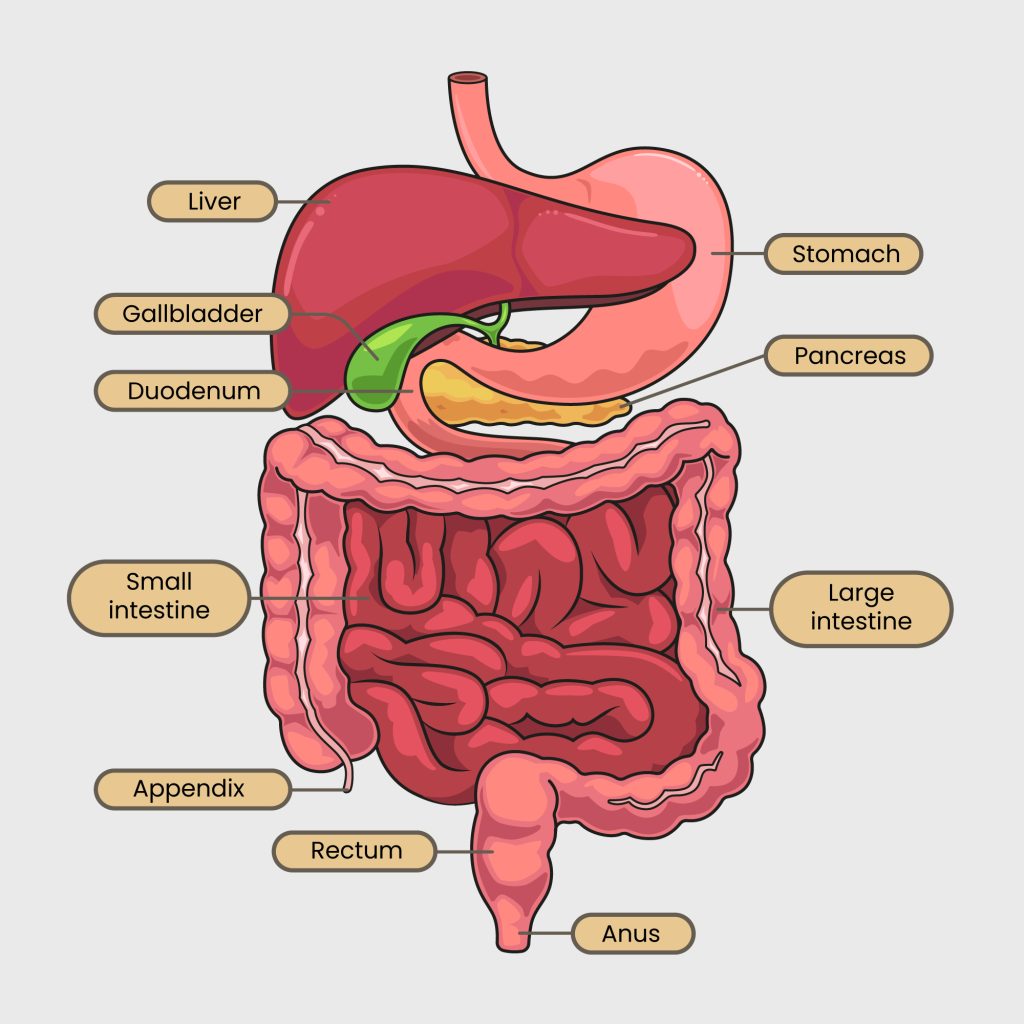
If you’ve ever been told to “heal your gut” without really knowing what that means, you’re not alone. Digestion is one of the most complex processes in the human body, involving nearly a dozen organs working in careful coordination. When you understand how each part contributes, it becomes a lot easier to see why gut health matters so much and why the small changes in your treatment plan can make a real difference.
Let’s walk through the entire journey, from the moment you smell your food to the moment your body eliminates what it doesn’t need.
What Does Digestion Actually Do?
Every bite of food you eat is a package of raw materials your body cannot use in its current form. Digestion is the process of breaking that package down into small enough pieces to be absorbed into your bloodstream and used for energy, growth, and repair.
Broadly speaking, digestion has three main jobs:
- Proteins break into amino acids
- Fats break into fatty acids and glycerol
- Carbohydrates break into simple sugars, like glucose
- Micronutrients are extracted, such as vitamins and minerals
None of this happens in one single step. It’s an assembly line, and every organ along the way has a specific job to do.
Stage One: The Mouth
Digestion actually begins before food touches your tongue. The smell and sight of food trigger your brain to signal your salivary glands, which start producing saliva in anticipation. This is the reason your mouth waters when you smell something delicious.
Once you start chewing, saliva gets to work in two ways:
- Mechanical breakdown: chewing physically breaks food into smaller pieces, increasing the surface area for chemical digestion later on
- Chemical breakdown: saliva contains an enzyme called amylase, which begins breaking down starches (complex carbohydrates) into simpler sugars right there in your mouth
This is why a piece of bread can start to taste slightly sweet the longer you chew it. Saliva also contains lipase, a fat-digesting enzyme, though its role here is minor compared to what happens later in the process.
Once food is chewed and moistened, it’s formed into a soft mass called a bolus, ready to be swallowed.
Stage Two: The Esophagus (The Delivery Tube)
The esophagus doesn’t digest anything, but it plays a critical role: transporting the bolus from your throat to your stomach. It does this through peristalsis, a wave-like muscle contraction that pushes food downward, which is also why you can technically swallow food even if upside down.
At the bottom of the esophagus is the lower esophageal sphincter, a muscular valve that opens to let food into the stomach and then closes to keep stomach acid from splashing back up. When this valve doesn’t close properly, it can lead to acid reflux.
Stage Three: The Stomach (The Acid Bath)
The stomach is where digestion really ramps up. It acts as a mixing and breakdown chamber, using both muscular contractions and powerful chemicals.
Stomach acid, primarily hydrochloric acid, serves several essential purposes:
- Activating pepsin, the enzyme responsible for breaking down protein into smaller pieces called peptides
- Killing off harmful bacteria and pathogens that come in with food
- Helping release minerals like iron, zinc, and calcium from food so they can be absorbed later
The stomach churns food into a thick liquid called chyme, which is then slowly released into the small intestine.
It’s worth noting that stomach acid is often misunderstood. Many people assume digestive discomfort means “too much acid,” but low stomach acid can cause very similar symptoms, including bloating, reflux, and poor nutrient absorption. This is one of many reasons a personalized treatment plan matters more than a one-size-fits-all approach.
Stage Four: The Small Intestine (Where the Real Absorption Happens)
The small intestine is the workhorse of the digestive system. This is where the majority of nutrient breakdown and absorption takes place, and it doesn’t do it alone. Several supporting organs contribute critical substances here.
The Pancreas: The Enzyme Factory
The pancreas releases a cocktail of digestive enzymes into the small intestine, including:
- Amylase, to continue breaking down carbohydrates
- Protease, to continue breaking down proteins into amino acids (remember that pepsin started this process back in the stomach)
- Lipase, to break down fats into absorbable fatty acids
- Bicarbonate, while not a digestive enzyme, it is a chemical that neutralizes the acidic chyme coming in from the stomach. Increasing the pH (ie becoming less acidic) helps the digestive enzymes function properly and prevents the intestinal lining from being damaged.
The Liver and Gallbladder: The Bile Duo
Fat digestion requires a special helper because fat and water don’t naturally mix. That’s where bile comes in.
- The liver produces bile, a substance that acts like a detergent, breaking large fat molecules into smaller droplets so that the lipase enzyme can more easily split them into fatty acids.
- The gallbladder stores and concentrates bile between meals, then releases it into the small intestine when fatty food arrives.
Bile is also the primary route through which your body eliminates excess cholesterol and certain waste products. It also plays a role in absorbing the fat-soluble vitamins A, D, E, and K.
Absorption Along the Intestinal Wall
The inside of the small intestine is lined with tiny finger-like projections called villi, which create a massive surface area (about the size of a tennis court, if flattened out). This is where absorption takes place:
- Absorption into the bloodstream:
- Simple sugars (from carbs), amino acids (from proteins), small particles of fatty acids, minerals, and most vitamins.
- Absorption into the lymphatic system:
- Large particles of fatty acids and fat-soluble vitamins (vitamins A, D, E, and K)
- Compounds absorbed into the lymphatic system join the bloodstream later on
By the time contents leave the small intestine, most of the usable nutrients have already been extracted and absorbed.
Stage Five: The Large Intestine (Water Recovery and Microbial Magic)
What’s left after the small intestine finishes its job is mostly water, fiber, and other undigested material. This moves into the large intestine, or colon, which has two major jobs:
- Reabsorbing water and electrolytes, which is why stool becomes firmer as it moves through the colon
- Housing your gut microbiome, trillions of bacteria and other microbes that ferment soluble fiber for their own energy source.
The Role of Your Microbiome
Your gut bacteria aren’t just passengers, they’re active participants in your health. A healthy, diverse microbiome has many jobs:
- Ferments soluble fiber into short-chain fatty acids like butyrate, which nourish the cells lining your colon and help reduce inflammation
- Produces certain vitamins, including some B vitamins and vitamin K
- Helps train and regulate your immune system, since a large portion (70% -80%) of your immune cells live in the large intestine
- Competes with harmful bacteria for space and resources, helping keep pathogens in check
- Communicates with the brain through the gut-brain axis, which is part of why gut health is so closely tied to mood and mental clarity
When the balance of gut bacteria is disrupted, a state often called dysbiosis, it can contribute to bloating, irregular bowel habits, food sensitivities, low-grade inflammation, and a compromised immune system. Since dysbiosis is so closely tied to various chronic conditions, it is critical to keep our gut bacteria in a healthy balance.
Stage Six: Elimination
After the large intestine (and our gut bacteria) do their jobs, the only thing left is waste products. These waste products are primarily insoluble fiber, dead bacteria, shed intestinal cells, and a small amount of water. This waste is compacted into stool and is eliminated from the body. The entire journey from first bite to elimination typically takes between 24 and 72 hours, though this varies quite a bit from person to person and can be a useful marker of digestive health.
Why This Matters for Your Treatment Plan
Every organ in this system depends on the ones before it. If stomach acid is too low, protein digestion suffers. If bile flow is sluggish, fat digestion and fat-soluble vitamin absorption both take a hit. If the microbiome is out of balance, the large intestine can’t do its job of finishing digestion and supporting the immune system. Etc etc. Throughout the digestive system (and indeed the entire body), everything is connected and relies on functioning parts higher up the chain.
This is exactly why gut health treatment plans often address multiple points along this pathway rather than a single symptom. Understanding where in this chain your own digestion needs support can make treatment recommendations feel less like arbitrary instructions and more like targeted therapy.
If you have questions about where your own digestive process may need extra support, give us a call! We’re here to help you figure it out!